
If you’ve ever searched for kindergarten money worksheets or Grade 1 math printables for 6–7 year olds, you’ve probably noticed something: most worksheets focus on counting coins or basic addition.
That’s important — but I also wanted to introduce something deeper.
This printable cash flow worksheet from RookieMBA helps young learners practice addition, subtraction, and multiplication while quietly introducing early financial literacy concepts in a way that actually makes sense to them.
And it does it through story. This worksheet is related to the book ABCs of MBA.
A Real-World Money Worksheet for 6 and 7 Year Olds
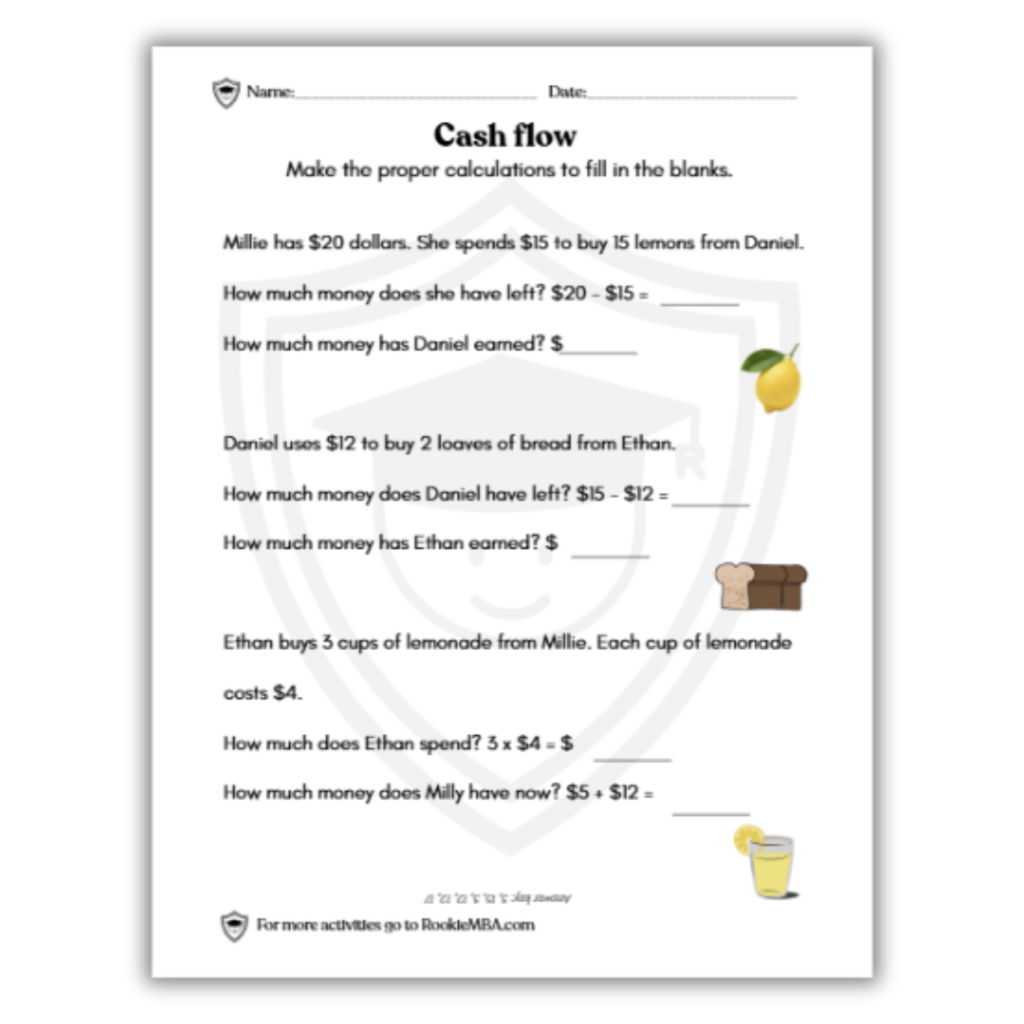
This worksheet follows three simple characters — Millie, Daniel, and Ethan — as they buy and sell lemons, bread, and lemonade.
Instead of random numbers on a page, students solve math problems based on what’s happening in the story:
- Millie starts with $20 and spends $15.
- Daniel earns money, then spends some.
- Ethan buys lemonade using multiplication (3 × $4).
For kindergarten and Grade 1 students, this reinforces:
- Subtraction within 20
- Basic multiplication concepts
- Understanding “money left” after spending
- The idea that when one person spends, someone else earns
It’s math — but it feels practical.
Kindergarten & Grade 1 Math Skills Practiced
If you’re specifically looking for worksheets for 6 year olds or 7 year olds, here’s what this activity supports:
✔ Addition and Subtraction Within 20
Students calculate how much money is left after purchases.
✔ Early Multiplication Exposure
3 cups × $4 introduces repeated addition in a real context.
✔ Word Problem Comprehension
Children read short, simple scenarios and pull out key numbers.
✔ Beginning Financial Literacy
They see that businesses have expenses, not just earnings.
This makes it ideal for:
- Kindergarten enrichment
- Grade 1 math centers
- Homeschool math practice
- Early elementary financial literacy lessons
Why Story-Based Worksheets Work Better for Young Learners
Six and seven year olds learn best when numbers are tied to something concrete.
When they see:
Millie has $20. She spends $15.
They can picture it.
That’s very different from:
20 − 15 = ___
Same math. Very different engagement.
Story-based worksheets help children:
- Build logical thinking
- Understand cause and effect
- Connect math to real life
And when math feels useful, resistance drops.
Who This Cash Flow Worksheet Is For
This printable is especially helpful if you are:
- A parent looking for free Grade 1 math worksheets
- A teacher searching for kindergarten money activities or for Career Week
- A homeschool parent teaching basic business or financial concepts
- Building a math center for 6–7 year olds
It works well as:
- Independent practice
- Small group work
- A discussion starter about earning and spending
Extending the Learning at Home or in Class
Once your child finishes the worksheet, try asking:
- Who made the most money?
- Who had to spend money to make money?
- What if lemonade cost $5 instead of $4?
- What if Millie sold 5 cups instead of 3?
Those small variations turn one worksheet into a full lesson.
Download This Kindergarten & Grade 1 Money Worksheet
You can download the full printable cash flow worksheet inside this post.
It’s simple, clean, and designed specifically for early elementary learners who are just beginning to connect math with real-world situations.
If you’re looking for more kindergarten worksheets, Grade 1 math printables, and early business literacy activities, you can find additional resources at RookieMBA.
Teaching kids how money moves doesn’t have to wait until middle school.
It can start with subtraction, lemonade, and a single page.