
If you’re looking for a structured, educational rainy day activity for kids, this free accounting for kids cash book printable offers both academic value and real-world relevance.
Using a simple lemonade stand scenario, children practice reading, addition, subtraction, and basic financial tracking — all through a clear, step-by-step cash book exercise.
No one asked, but I actually studied Accounting in college, and took all the professional exams to qualify to work as an accountant 😂🥲 Not sure whether to laugh or cry about that one.
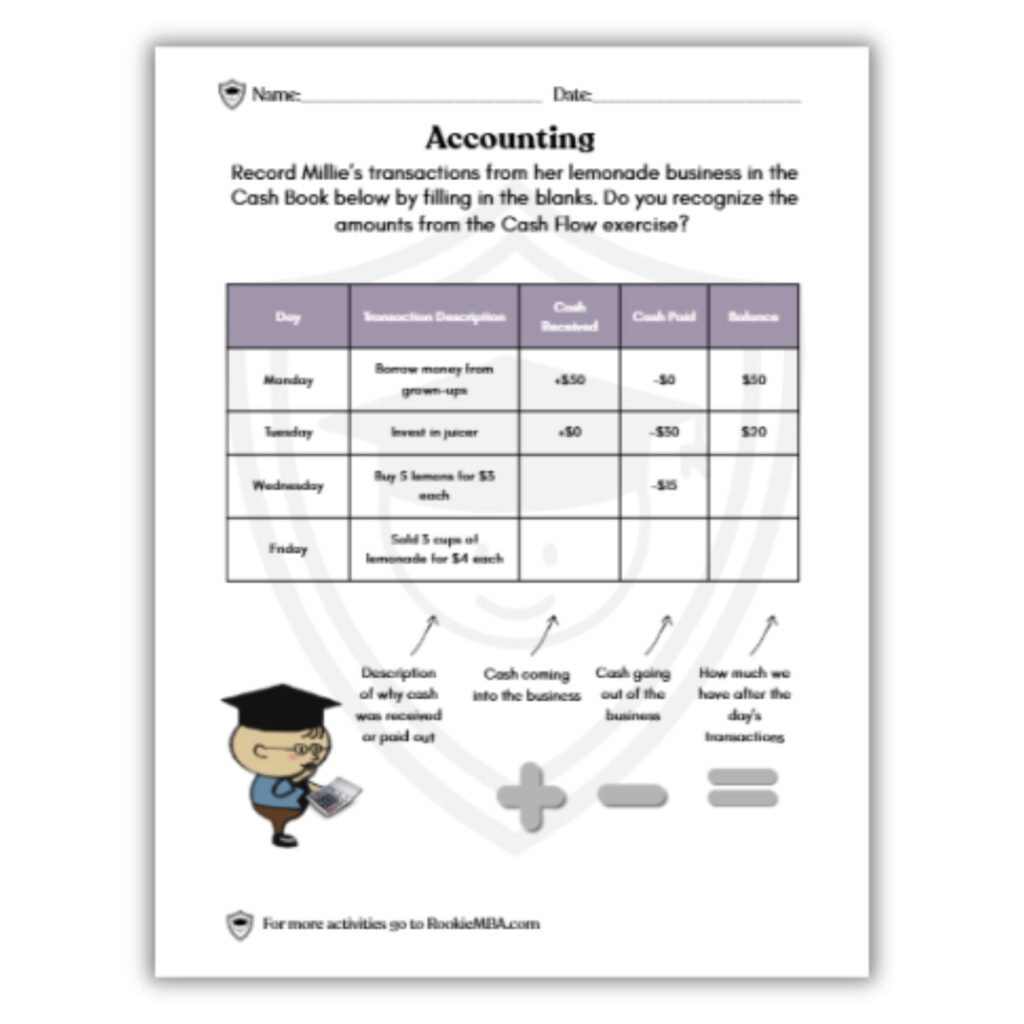
What Is This Accounting for Kids Printable?
This worksheet introduces accounting for kids through a simplified cash book format.
Children are asked to:
- Read short daily transactions
- Identify money coming into the business
- Identify money going out of the business
- Calculate the updated balance after each day
The activity follows Millie and her lemonade business across several days. Students track what happens when she:
- Borrows money
- Invests in equipment
- Buys lemons
- Sells lemonade
This mirrors real bookkeeping — presented at a child-friendly level.
Why This Is a Smart Rainy Day Activity for Kids
When outdoor play isn’t an option, many parents look for meaningful indoor learning activities. This worksheet works well as a rainy day activity for kids because it:
- Keeps children focused with a real-world scenario
- Reinforces math skills without feeling repetitive
- Encourages logical thinking
- Introduces entrepreneurship concepts
Unlike passive screen time, this printable requires active reasoning and decision-making.
Concepts Taught in This Accounting for Kids Exercise
1. Cash In vs. Cash Out
Children learn to distinguish between:
- Cash received (sales, borrowing)
- Cash paid (supplies, equipment)
This is the foundation of bookkeeping.
2. Running Balance
After each transaction, students calculate the new balance.
This reinforces:
- Sequential thinking
- Addition and subtraction
- Attention to detail
They see that every financial action changes the outcome.
3. Business Cause and Effect
The lemonade stand scenario demonstrates:
- Borrowing increases available cash
- Buying supplies reduces cash
- Selling products increases cash
These simple patterns introduce business logic in an accessible way.
Skills Reinforced
This accounting for kids printable strengthens:
- Basic arithmetic
- Reading comprehension
- Financial vocabulary
- Analytical thinking
- Early money management skills
It is especially helpful for children who learn best through applied, real-world examples.
How to Use This Worksheet at Home or in Class
Step-by-Step Guidance
- Read each transaction together.
- Ask: Is this money coming in or going out?
- Fill in the appropriate column.
- Calculate the updated balance.
- Discuss the result.
For younger children, model the first entry and then allow them to continue independently.
Extend the Learning
After completing the cash book:
- Calculate total cash received.
- Calculate total cash paid.
- Determine whether Millie made a profit.
- Have your child create their own small business scenario.
This can easily expand into a multi-day financial literacy project.
A Practical Introduction to Accounting for Kids
Early exposure to financial concepts builds long-term confidence. This accounting for kids worksheet introduces bookkeeping in a structured, manageable way.
As a rainy day activity for kids, it provides productive screen-free learning while building foundational money skills.
Simple numbers. Clear logic. Real-world thinking.